
Signs a London Radiator System Needs a Power Flush
The clearest signs of sludge are radiators that stay cold at the bottom, dark water when you bleed them, and a boiler that bangs or takes ages to heat the house. A radiator that's cold only at the top is usually trapped air, which you can often sort yourself. When several sludge signs show up together, an assessment is worth booking.
Sludge builds up slowly, so it's easy to get used to a heating system that isn't working properly. Rust and debris form inside steel radiators and pipes over the years. That black, gritty mix is called magnetite, and it settles wherever the water moves slowest. The good news is that it leaves fairly clear clues. Here's what to look and listen for.
- Cold at the bottom, warm at the top. Sludge is heavy, so it sinks to the base of the radiator and blocks the hot water flowing through it. This is the classic sign.
- Some radiators hot, others barely warm. If rooms near the boiler are toasty but rooms further away stay cool, even after bleeding, sludge may be choking the flow before it gets there.
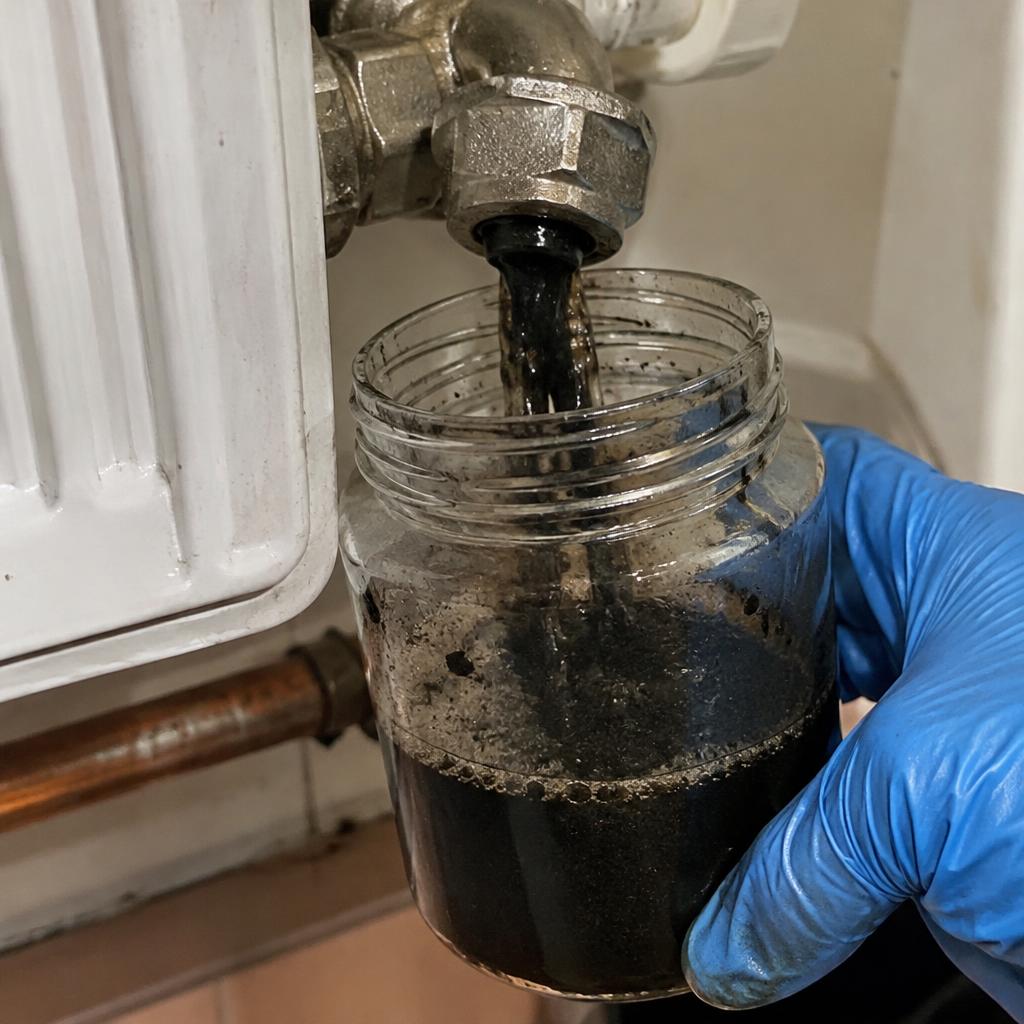
- Black or brown water when you bleed a radiator. Clean system water should be close to clear. Dark, inky water means magnetite is moving around your system.
- You need to bleed the radiators again and again. If air keeps coming back within weeks, corrosion inside the system could be making gas.
- Noisy heating. Banging, knocking or a kettle-like rumble from the boiler can mean sludge is restricting flow, so the water overheats in spots.
- Slow to warm up. If the house takes much longer to heat than it used to, poor circulation is one of the usual reasons.
- Repeat boiler or pump faults. Debris wears out parts and blocks narrow passages. If the same parts keep failing, dirty water may be the real cause.
One of these signs on its own doesn't always mean you need a flush. Two or three together, especially cold bottoms plus dark water, is a much stronger hint.
Some symptoms look like sludge but aren't. Here's how to tell the difference before you spend any money:
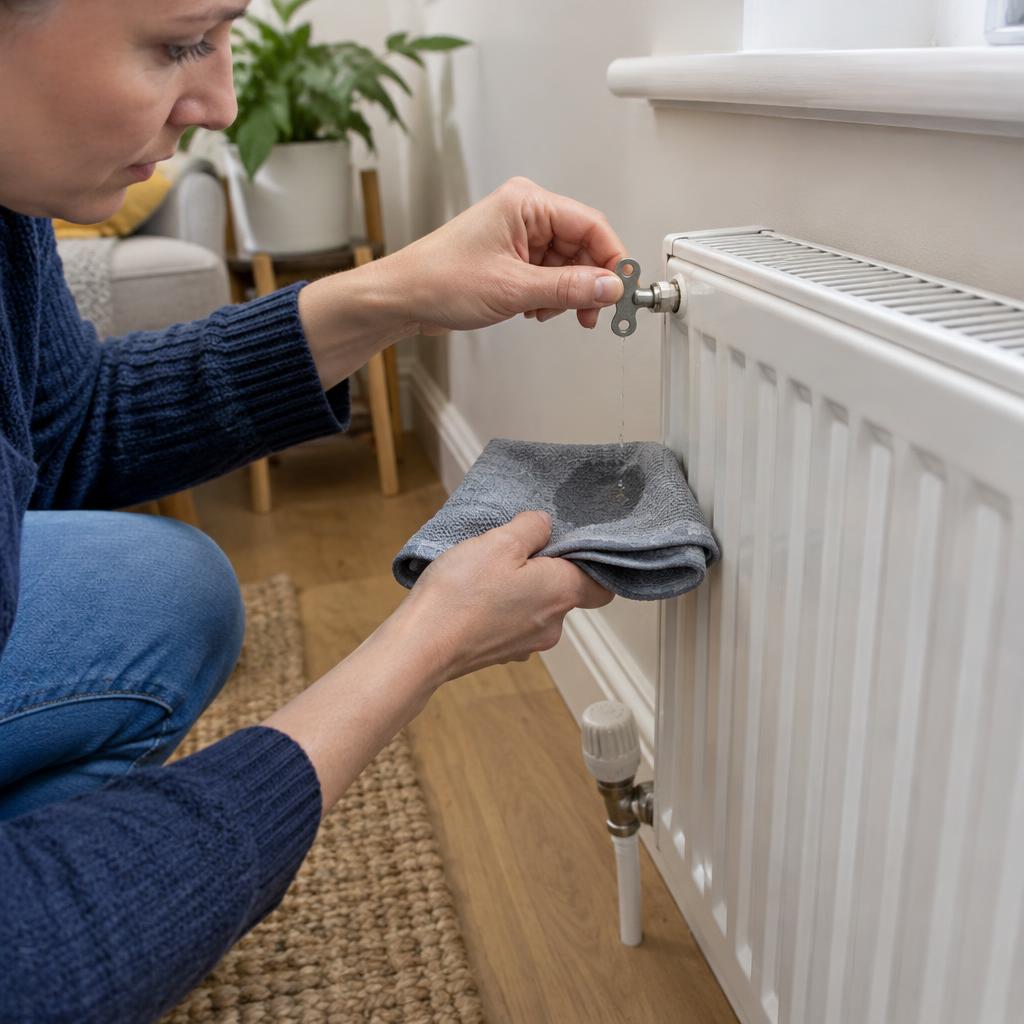
- A radiator that's cold at the top and warm at the bottom usually has trapped air. Bleeding it with a radiator key often fixes it in a couple of minutes.
- A single radiator that's completely cold while the rest work fine may have a stuck valve rather than a system-wide sludge problem.
- If the whole system is cold, the boiler may not be firing at all. That's a repair job, not a flushing one.
We'd rather you try bleeding a radiator first than pay for work you don't need. If bleeding doesn't help, or the water that comes out is black, that's when a proper look makes sense.
Lots of London homes and rental flats have heating systems that have been added to over the years. You might have a new radiator in a loft room or a replacement boiler on old pipework. Mixed systems like these can be harder to read from the symptoms alone. Landlords can also miss the early signs, because the first person to notice a cold bedroom is usually the tenant.
Symptoms point you in the right direction, but they don't prove anything. Our team checks the system before recommending a power flush, so you'll know whether sludge is really the cause, or whether a simpler fix like balancing the radiators or a heating repair is the better answer.
When a Single Cold Radiator Does Not Mean a Full Flush
A power flush cleans your whole heating system, every pipe and every radiator. If only one radiator is playing up and the rest of the house heats well, the cause is usually in or near that one radiator. Flushing the entire system for a local fault is like servicing the whole car because one tyre is flat.
Beyond trapped air and the stuck valves covered above, these are the common local causes that don't call for a flush:
- The system isn't balanced. Hot water takes the easiest route. Radiators close to the boiler can grab most of the flow, so the one at the far end gets very little. Adjusting the valves so each radiator gets its fair share often sorts this out.
- A valve was closed and never reopened. Radiators often come off the wall for decorating or new flooring. If the small valve at one end, called the lockshield, isn't opened back up properly, that radiator stays cool. It's a common cause of one cold room in a freshly redecorated flat.
- One radiator has filled with sludge, but the rest are clean. Sludge sometimes collects mostly in one radiator, often an old one or one on a slow part of the system. That single radiator can be taken off and cleaned out on its own, without flushing everything.
- The radiator itself is worn out. Very old radiators can rust from the inside, with weeping seams or pinhole leaks. Cleaning won't fix corroded metal. Replacing that radiator is the honest answer.
Here's a typical example. A tenant in a converted Victorian flat says the back bedroom has been cold since the decorators left. Every other radiator is hot from top to bottom, and the water from the bleed valve runs clear. That points to a valve or balancing issue, not a sludge-filled system. A full flush wouldn't be the right first step there.
These smaller jobs fall under our central heating and radiator services or a heating system repair, rather than a power flush.
A single cold radiator isn't always a one-off, though. It's worth a closer look at the whole system if:
- The water you bled from it was black or brown. Magnetite in one radiator usually means there's more moving around elsewhere.
- A second or third radiator has started going cold at the bottom over the past few months.
- That radiator was cleaned or replaced before, and the same problem came back.
- The boiler is also getting noisier or slower to heat the house.
In those cases, the cold radiator is often just the first place the sludge has shown itself, and treating it alone may only buy you a little time. If none of those apply, start with the simple, local fix. You may well find that's all your heating needed.
What Happens During a Domestic Power Flush
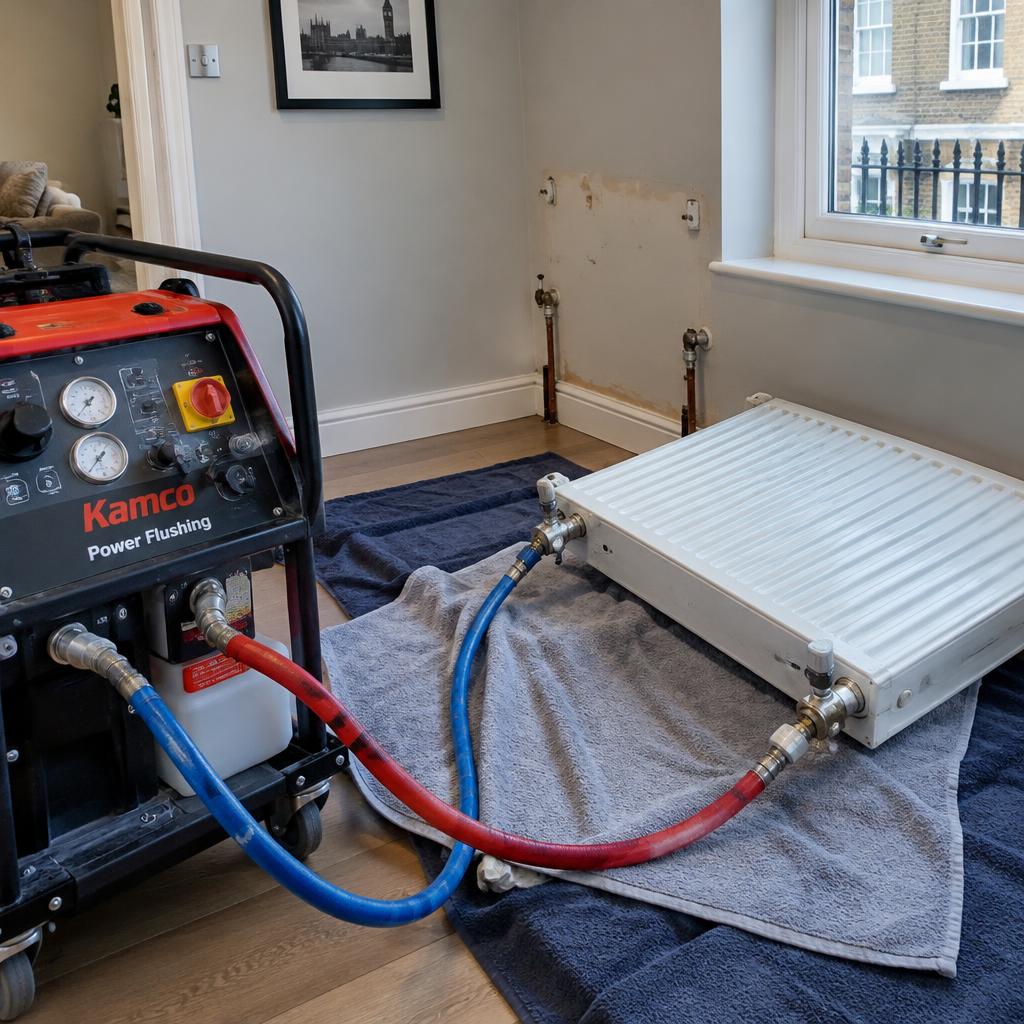
A power flush pushes water and cleaning chemicals through your heating system at a much faster flow than your boiler's own pump can manage. That strong flow loosens the sludge and magnetite sitting in your radiators and pipes, then carries it out to a drain. Fresh water replaces the dirty water until it runs clear. For an average home it usually takes most of a day, and bigger houses with more radiators take longer.
Here's how a typical domestic power flush runs, step by step.
- Checking the system first. The engineer looks at the boiler, the radiators and any pipework they can see. They'll note the system type, whether it's a combi, a system boiler or an older setup with a tank in the loft, and look for weak spots or existing leaks before any cleaning starts.
- Connecting the flushing unit. A flushing machine is connected into the heating circuit. It's often fitted where the circulating pump sits, or across the pipes of one radiator. Your boiler isn't used to drive the flush.
- Adding a cleaning chemical. A cleaner goes into the system water to help break up the sludge and lift rust and scale off the inside of the metal.
- Working through each radiator. The radiators are usually cleaned one at a time. The engineer closes off the others so the full flow goes through one radiator, and may switch the direction of flow back and forth to shift stubborn deposits. Tapping or gently vibrating the radiator helps loosen sludge packed into the bottom.
- Dumping the dirty water. The dark water is flushed out to a drain while clean mains water comes in. This carries on until the water coming out runs clear and tests clean.
- Refilling and protecting. The system is refilled with fresh water and an inhibitor is added. Inhibitor is a liquid that slows down future corrosion inside the radiators and pipes.
- Bleeding, balancing and final checks. The radiators are bled, the system pressure is set, and the radiator valves are adjusted so heat reaches every room evenly.
You don't need to move out or turn the house upside down. It helps to clear the space in front of each radiator and around the boiler, and to know where your nearest outside drain or downstairs toilet is, because the dirty water has to go somewhere. Your heating and possibly your hot water will be off while the work is going on, so you'll want a plan for that day.
There's one thing worth being honest about. In older systems, sludge can sometimes sit over a tiny weak spot in a pipe joint or an old radiator and quietly seal it. Once the sludge is cleaned away, that weak spot can start to weep. It's not caused by the flush, but the flush can show it up. That's one reason checking the system before starting matters so much, especially in London houses and flats where the pipework may be decades older than the boiler.
Afterwards, the things you'd normally notice are radiators heating more evenly from top to bottom, clearer water if you bleed them, and a quieter boiler. How much difference you'll feel depends on how much sludge was in there and on the condition of the boiler and radiators. A flush cleans the system. It can't repair a part that's already worn out.
Domestic Power Flushing Versus Commercial Jobs
A domestic power flush cleans the heating in one home. That usually means one boiler, a set of radiators and the pipes that link them. A commercial flush covers bigger systems that heat many rooms, many units or a whole building. The basic idea is the same, which is to shift sludge and magnetite and get the water moving freely again. The size, the planning and the way the job is booked are quite different.
What matters is the heating system itself, not whether the building is a house or a business. These examples should help you work out which one you've got:
- A house or flat with its own boiler. This is a domestic job, even if you rent it out. A landlord with three flats, each with its own combi boiler, has three domestic systems.
- A converted Victorian house split into flats, each with its own boiler. Each flat is usually treated as its own domestic system.
- A block of flats with one shared plant room heating every unit. This is a communal system and falls under commercial work.
- Offices, shops, restaurants, schools, care homes and other business premises with larger boilers, more than one boiler or long pipe runs. These are commercial systems.
- A small shop or office heated by a single domestic-size boiler and a few radiators. This can be closer to a domestic job. Tell us about the setup and we'll point you to the right route.
Bigger systems carry more water, use wider pipes and often include parts you won't find in a home, such as several boilers working together or a separate heat exchanger. They also tend to serve people who can't just go without heating for a day. Tenants, staff, customers or residents all need to be thought about. That's why commercial jobs need more planning than a domestic flush.
With a domestic power flush, the cost mostly depends on things you can count or see. That includes how many radiators you have, the type of boiler and system, how easy the pipework is to reach, and how much sludge has built up. A two-bedroom flat with six radiators is a smaller job than a four-bedroom house with fifteen. Older systems with a tank in the loft can also take more work than a modern sealed combi setup.
Here's how booking works with us. Domestic jobs take a £60 standard booking deposit. For commercial systems, we start with a survey, and commercial surveys are free. Once the work is agreed, commercial systems require a 50% deposit. If the survey shows your system doesn't need a full flush, you'll hear that from us too.
We specialise in both domestic and commercial power flushing, and we cover all of London and Greater London. That means one team can look after a single rented flat, a converted house of separate units, or a building with a shared plant room.
Not sure if your property counts as domestic or commercial? Call us on 020 8798 2588 or send an enquiry through our website. Tell us a bit about the building and the heating, and we'll help you book the right visit or arrange a free commercial survey.
What Drives the Cost of a Power Flush
There's no single price for a power flush, because no two heating systems are quite the same. Most of the cost comes from time and from what the engineer finds once the system is opened up. The best way to avoid surprises is to understand how quotes are usually built, and what can change them.
Across the trade, power flushes are usually priced in one of two ways. Some companies charge per radiator, so a bigger house costs more in a fairly predictable way. Others give a fixed price for the whole system based on a look at it first. Neither is better on its own. What matters is that you know which one you're getting and what it covers.
Beyond the size of the system, these are the things that tend to move the cost up or down:
- Seized or worn valves. If a radiator valve won't turn or snaps when it's touched, it has to be replaced before that radiator can be cleaned properly. On older systems this can add parts and time.
- How bad the sludge is. A system with light deposits may clear quickly. One that's packed solid can need longer on each radiator and a stronger cleaning treatment.
- Weak spots that show up during the work. As explained above, a flush can expose an old joint or radiator that was only being held together by sludge. Fixing that is a repair on top of the flush.
- Getting the dirty water out. A ground-floor house with an outside drain is simple. A top-floor flat in a mansion block, with no easy drain and a long walk to the van, takes more effort.
- What's added at the end. Inhibitor is normally part of a proper flush. Some quotes also include extra protection for the system, and others list it separately.
A low quote that skips the checks, the inhibitor or the balancing isn't really cheaper if the radiators are cold again a year later. When you compare prices, compare what's being done.
Before you agree to any power flush, it's worth asking these questions:
- Is the price per radiator or for the whole system?
- Does it include inhibitor, bleeding and balancing the radiators?
- What happens if a valve or radiator needs replacing during the job, and will I be told before any extra work starts?
- Will you check the system first, or start straight away?
- If my boiler is old or faulty, does a flush still make sense, or should I think about a new boiler instead?
That last question matters more than people expect. If your boiler is near the end of its life, cleaning the system and then replacing the boiler soon after can mean paying twice for disruption. Talking through both options together with our boiler installation team can save that. And if a repair turns up during the visit, our boiler and heating repairs take the cost of materials, so you'll know where that part of the cost comes from.
If your radiators are showing the signs of sludge and you'd like a clear answer on whether a power flush is the right fix, call us on 020 8798 2588 or send an enquiry through our website. We cover all of London and Greater London.