
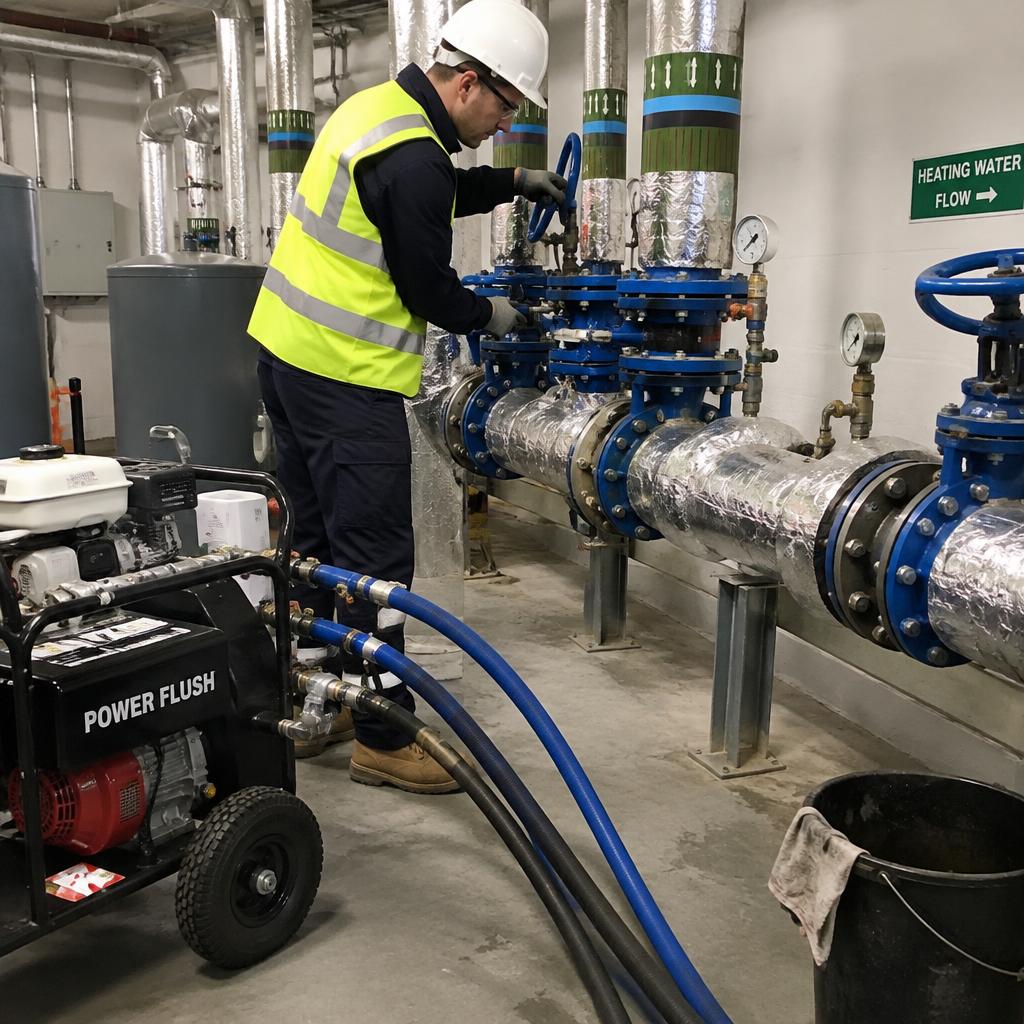
Commercial Power Flushing Covers Multi-Unit and Shared Heating Systems
Shared heating systems serve many rooms, flats or floors from one source, so a problem in the water affects everyone on the loop. Commercial power flushing treats the system as a whole rather than one radiator at a time. A free commercial survey is the sensible first step, because it shows what the system needs before any work is agreed.
A home usually has one boiler and a handful of radiators. A shared system is different. It might be a block of flats run from one plant room, an office with heating across several floors, or a shop with flats above that share pipework. The water moves a long way through a lot of pipe before it gets back to where it started.
That distance matters. Sludge and magnetite, the black, muddy deposits that build up inside heating systems over time, don't stay put. They travel with the water and settle wherever the flow is weakest. In a big building, that's often the far end of a run or the top floor. So one tenant might be warm while another, two floors up, has radiators that are cold at the bottom and barely lukewarm at the top.
If you manage a building like this, you've probably heard the same complaint from different people in different words:
- Some flats or offices heat up well while others never seem to get warm
- Radiators with cold patches, often at the bottom where sludge collects
- Heating that takes much longer to come up to temperature than it used to
- Banging, gurgling or rushing noises in the pipes or near the boiler
- Radiators being bled again and again with no lasting change
These signs point to poor circulation, and on a shared system they usually come from the whole loop, not one faulty radiator. Fixing a single unit rarely solves it, because the dirty water keeps moving round the building. That's why commercial power flushing looks at the system as one connected job.
Shared systems also bring practical questions a house doesn't. Which units can be reached, and when? Do tenants or staff need notice? Is the plant room easy to get into? How much heating can people do without, and for how long? A larger system can need more planning than a domestic flush, and the answers shape how the work fits around the people using the building.
This is where our free commercial survey comes in. It lets us look at the actual system, how it's laid out and where the problems are showing, before anything is agreed. You get a clear picture of what the building needs, and you don't pay to find out. If the survey shows the issue isn't sludge at all, it's better to know that before booking a flush. That might be a faulty pump, a boiler problem or a balancing issue, which our heating system repair or commercial heating work can look at instead.
If you go ahead with work on a commercial system, a 50% deposit is required. We cover all of London and Greater London, so it doesn't matter whether your building is a converted terrace split into flats or a modern office block. The first step is the same: get the system surveyed and find out what's really going on in the pipes.
Signs a Commercial Heating System Needs a Power Flush
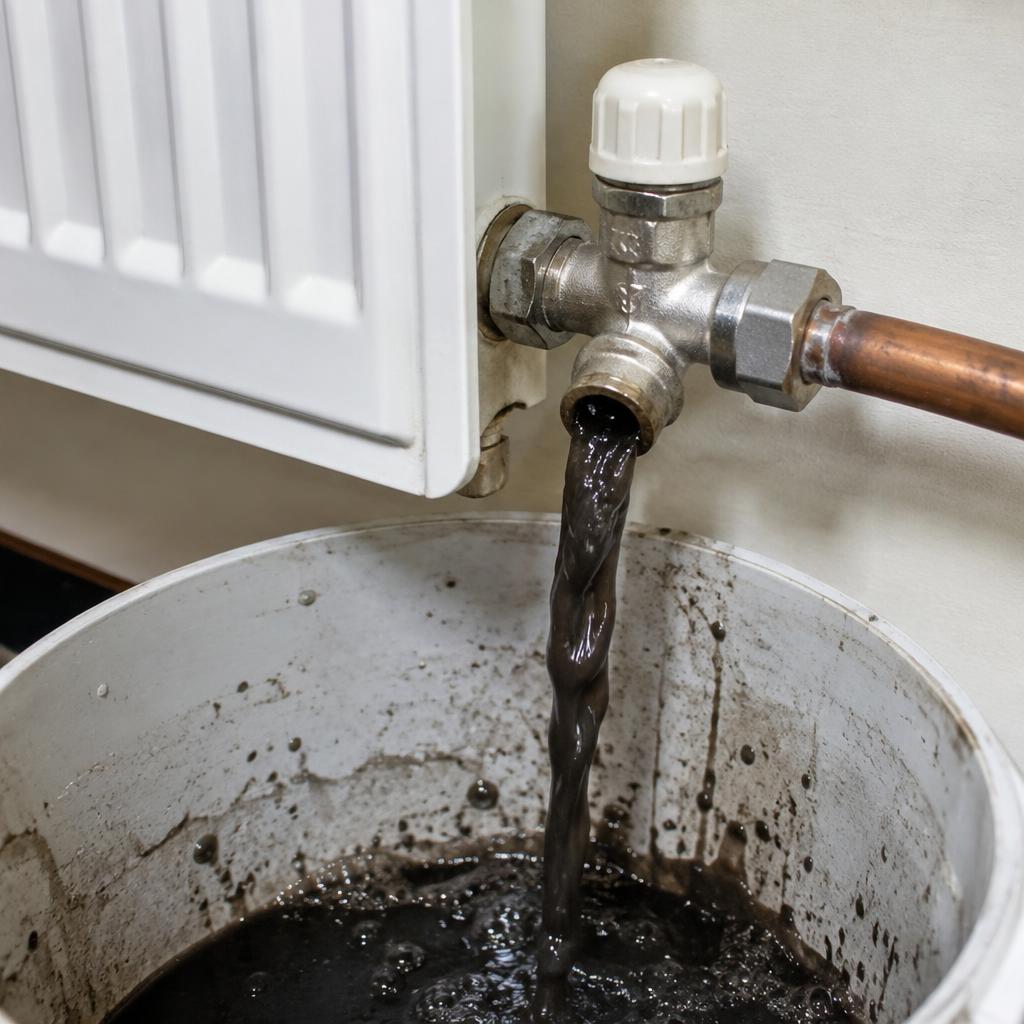
The clearest sign is what comes out of the system. Bleed a radiator, or have a maintenance person do it, and look at the first water that runs out. Clean system water is close to clear. If it's black, brown or looks like thin mud, that's magnetite and sludge moving round the pipes. On a shared system, that dirty water is in every radiator on the loop, not only the one you opened.
There are other signs that point the same way, and they're easy to miss because they look like separate problems:
- Radiators that were replaced recently but have started going cold at the bottom again. The new radiator was fine. The water going into it wasn't.
- A circulating pump that keeps failing or needs replacing more often than it should. Sludge is abrasive and can clog pumps.
- A boiler that makes a kettle-like rumbling or knocking sound, which can mean deposits are restricting flow through its heat exchanger.
- Thermostatic radiator valves that stick, seize or stop responding.
- Pinhole leaks or weeping joints on radiators, especially older ones, which can be a sign of corrosion working from the inside.
- A system that needs topping up with water regularly. Fresh water brings in oxygen, and oxygen drives the corrosion that creates more sludge.
Timing matters too. If a new boiler is going onto older pipework, the old system water can carry sludge straight into the new boiler. Cleaning the system before or during a boiler installation is a sensible way to protect the new equipment. The same applies after major alterations, such as a refit that adds radiators or reroutes pipes, because disturbed pipework can release deposits that had settled for years.
Not every heating complaint is sludge. A radiator that's cold at the top but warm at the bottom usually has trapped air, and bleeding it should help. A single radiator that stays completely cold may have a closed or faulty valve. If nothing in the building heats up at all, the cause is more likely the boiler or the pump than the water. A flush won't fix any of these on its own.
Here's a typical picture. A landlord has a converted terrace split into four flats on one system. The ground floor tenant is happy. The top floor tenant says the bedroom radiator only gets warm halfway up, and the bathroom towel rail never gets properly hot. Someone bleeds both, and the water comes out dark grey. That combination of uneven heat, cold lower sections and dirty water is a strong pointer towards a power flush.
If you've spotted two or three of these signs, it's worth getting the system looked at properly rather than replacing parts one at a time. That's what the free commercial survey is for. It confirms whether sludge is really the cause before you commit to anything.
A Free Commercial Survey Comes Before Any Quote
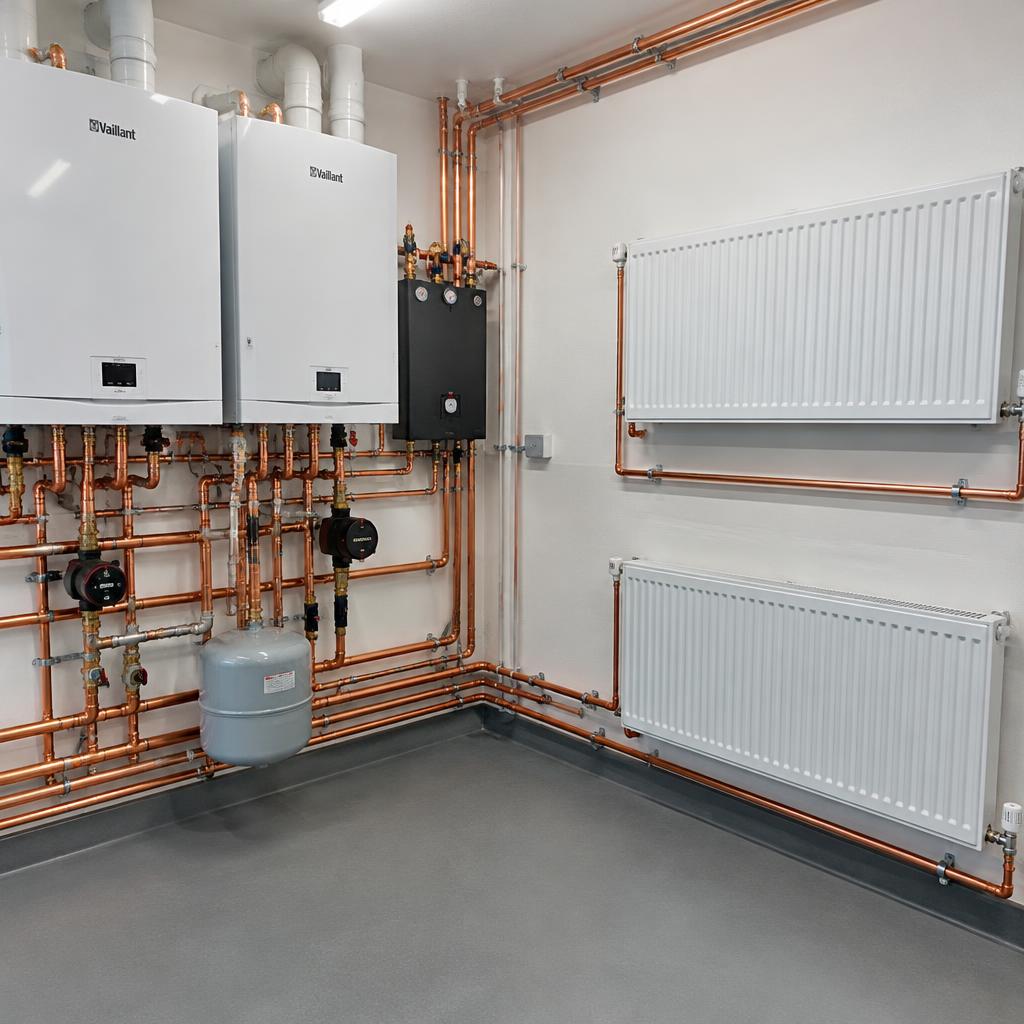
There's no honest flat rate for a commercial power flush. Two buildings with the same number of flats can need very different amounts of work, so any figure given over the phone without seeing the system is a guess. That's why the survey comes first and the quote comes after. The quote is then based on your actual building, not an average one.
Across the heating trade, these are the main things that push the cost of a commercial flush up or down:
- Size. This covers the number of radiators, units and floors, plus how long the pipe runs are.
- Type of system. An older open-vented system with a feed tank in the loft works differently from a sealed system, and a plant room with more than one boiler adds more to the job.
- Access. Getting into every flat or office matters, along with how easy the plant room is to reach and whether there's anywhere nearby to park and unload.
- Condition. Valves that have seized, or radiators that are badly corroded inside, may need replacing before or during the flush.
- Timing. Out-of-hours work, or doing the building in stages so everyone isn't without heat at once, takes more planning and time.
- Protection afterwards. This might include a magnetic filter to catch new debris and inhibitor to slow down fresh corrosion. Ask whether these are part of the job.
Some of this only shows up when someone looks. A radiator might seem fine from the outside but be thin with rust inside. Once the sludge holding it together is cleared, it can start to weep. A good survey should point out weak spots like this before the work starts, so you're not surprised halfway through.
Whoever you speak to, it's worth asking these questions before you agree to anything:
- Will the system be flushed all at once or in sections, and how long will each part be without heating?
- Which radiators or valves might need replacing, and is that in the quote or charged on top?
- Which flats, offices or rooms will need access, and how much notice should tenants or staff get?
- How will you show the water is cleaner afterwards?
- Is inhibitor or a filter included, or priced separately?
Clear answers to these give you something solid to take to a landlord, a freeholder or a residents' committee. They also make it easier to compare quotes fairly, because you'll know what each one covers.
The survey also leaves room for an honest answer you might not expect. Sometimes the system is in a state where replacing a few badly corroded radiators makes more sense than flushing them. Sometimes the building is fine and only needs a filter and some routine care. Knowing that before you spend anything is the whole point.
The survey costs nothing. If you then go ahead with the work, the 50% deposit for commercial systems applies, as mentioned above. We cover all of London and Greater London.
If your building has uneven heat, cold radiators or dark water when they're bled, book a free commercial survey through our enquiry form or call us on 020 8798 2588. We'll look at the system and tell you plainly what it needs.

What Happens During a Commercial Power Flush
A commercial power flush moves water through the heating system much faster than the boiler's own pump can. It also adds a cleaning chemical that loosens sludge and magnetite so they can be carried out of the pipes and drained away. On a shared system the idea is the same as in a house. The work is bigger and needs more planning around the people who use the building.
The exact method depends on the system, but the work usually goes through these stages.
- Getting ready. Tenants or staff are told when their heating will be off and which rooms need access. Radiator valves are opened fully, and anything that's seized is noted or freed so water can get through.
- Connecting the flushing unit. A separate flushing pump is connected into the heating circuit, often where the system's own pump sits or at a radiator. On a plant room with more than one boiler, each boiler is usually isolated so loose debris isn't pushed through it.
- Adding a cleaner. A chemical cleaner goes into the system water and circulates for a while to break up deposits stuck to the inside of pipes and radiators.
- Flushing in sections. Rather than trying to clean the whole building at once, the water is sent through one radiator, zone or floor at a time. This puts the full flow where it's needed. It also means parts of the building can stay warm while another part is being done.
- Reversing the flow. Switching the direction of the water helps shift sludge that has packed into corners and the bottoms of radiators. Gently tapping or vibrating radiators can help free stubborn deposits.
- Dumping dirty water. Water is sent to drain and replaced with fresh water until what comes out runs clear. Magnets are often used along the way to catch magnetite before it gets back into the system.
- Neutralising and refilling. Any leftover cleaner is flushed out or neutralised. The system is refilled and an inhibitor is added to slow down new corrosion. If a magnetic filter is part of the job, it's fitted here.
- Balancing and checking. Radiators are balanced so heat reaches the far end of each run and the top floors, not only the radiators nearest the boiler. The water is checked against how it looked at the start.
On older open-vented systems, the kind with a feed tank in the loft, the flush may need a gentler approach. Very old radiators and joints may not cope with full pressure. If the survey has already flagged thin or weeping radiators, they can be watched closely or replaced, which saves an unwelcome surprise partway through.
How long it takes is set by the size of the building, how many radiators there are and how many sections the work is split into. A small block of flats is a very different job from an office spread over several floors. Doing the work in stages, or outside working hours, can take longer overall but keeps disruption down for the people inside.
Afterwards, the clearest proof is the water itself. A radiator bled a few days later should give you water that's close to clear, not black or grey. You should also notice radiators heating more evenly from top to bottom. A flush can't promise to fix every heating complaint, but on a system clogged with sludge, cleaner water and better flow are what you're paying for.
If you'd like to know how a flush would work in your building, book a free commercial survey through our enquiry form or call us on 020 8798 2588.
When Power Flushing Isn't the Right Fix
A power flush only fixes one thing well: dirty water and the poor circulation it causes. If the problem in your building is something else, a flush won't help, and you'll have spent money and put up with disruption for nothing. These are the cases where we'd tell you to look elsewhere first. We've already covered trapped air, a single stuck valve and a building with no heat at all, so we won't repeat them here.
The system is losing pressure or leaking. If someone keeps topping the system up, find and fix the leak before anything else. Flushing a leaking system just means fresh water keeps coming in. That fresh water carries oxygen, which starts the corrosion all over again and washes out any new inhibitor. Repair first, then decide whether a flush is still needed.
The water is clean but the heat is still uneven. Bleed a radiator on the cold top floor. If the water comes out close to clear, sludge probably isn't the cause. A system that heats the radiators near the boiler well but leaves the far end of a run cool often just needs balancing. That means adjusting the valves so the water spreads fairly across the building. It's a much smaller job than a flush.
The contamination is light. A little discolouration in a system that still heats well doesn't always call for a full power flush. Sometimes a chemical clean, fresh inhibitor and a magnetic filter are enough to stop things getting worse. It's also worth knowing that flushes aren't routine maintenance you need every few years. A system that was cleaned properly, with good inhibitor levels and a working filter, may not need another one for a long time.
The pipework itself is failing. Older buildings can have pipes that are badly corroded, patched in several places or run in very narrow bore that's hard to clear. Pushing fast water and cleaning chemicals through pipework in that state can expose weak joints rather than fix anything. If the survey shows the pipes are near the end of their life, repiping or replacing sections may be the honest answer.
The heating is due to be replaced soon anyway. If a freeholder or residents' committee has already agreed to replace the whole heating system within a year or so, a full flush of the old one may be poor value. Cleaning still matters where new equipment joins old pipework, as covered above. Paying to restore a system that's about to be ripped out usually doesn't make sense.
- Leak or regular pressure loss: repair first
- Clean water but uneven heat: balancing
- Light discolouration with good heat: chemical clean, inhibitor and filter
- Failing or patched pipework: repair or replace sections
- Full replacement already planned: hold off on a flush
Where the fault turns out to be the boiler, the pump or the pipework rather than the water, our boiler repair and heating system repair work deals with that side of things. You're better off fixing the right problem than paying for a flush that was never going to solve it.